Skip to content

Your game.
Your words.

A workspace for game translators

Translate game dialogue, keep terminology consistent, and catch broken variables before export. Work locally, or share a project with your team.

Try a line.Interactive demo
ENTRIES3
quest.northern_gate1 / 3
Source

Hold the line, {player_name}.

Keep {player_name} in your translation. Try removing it to see the check.

Keep these in your translation

  • {player_name}Present
Token check passed.
Browser · JSON / CSV / POWindows · game-text extractionLocal-firstProtected tokensOptional cloud

What are you
starting with?

Choose a file type or game engine to check support and find the right editor.

Open your localization file.

In your browser

Open JSON, CSV, or PO in the browser. You can also return to a project saved here. No account needed.

JSONCSVPO / POT
Open the editor
No file handy? Use a sample.

Three game lines, in three formats. Download one, then open it in the editor.

Explore Northern Gate

Engine support, stated plainly

EngineReads and extracts
GodotSupportedScenes, CSV, PO, JSON databases and INKB dialogue, read natively. Unpacking a PCK uses GDRE, which you install and configure.
UnrealSupportedLOCRES, LOCMETA and String Table CSV, read natively. PAK and IoStore need repak or retoc; some UE5 asset versions stay partial.
UnityPartialLocalization tables, TextAsset JSON and CSV, and Ink, read natively. AssetBundles need UnityPy, and assets with a stripped type tree stay unreadable.

Supported means validated end to end on real game files. Partial means some variants work, with the limits written down. Helper tools run on your machine and are configured by you.

Write-back is always localization files — JSON, CSV, PO or an .lhproj project. The game’s own resources are never rewritten.

READ-ONLY EXTRACTION Extraction reads supported text into a new project. It does not change the original game files.

How game-folder extraction works
01

Game folder

Choose a game folder in the desktop app.

INPUT
02

Scan

Identify the engine and find supported text resources.

Scan
03

Extraction review

Choose the text to import and check its context.

Extraction review
04

Project

Create a LocalizationHub Project ready to translate.

READY TO TRANSLATE

Support varies by engine and file format. The scan results show what was extracted and what could not be read.

Keep the context.
Keep the code intact.

See the speaker and scene when the file includes them. Keep the dialogue natural and check variables and text tags before export.

SCENE 01 / TRANSLATION NOTES
SPEAKERCaptain VeyraSCENENorthern GateLISTENERPlayer
SOURCE

Hold the line, {player_name}. The Northern Gate does not fall tonight.

TRANSLATIONReady for review

اثبُت يا {player_name}. لن تسقط البوابة الشمالية الليلة.

Token check passed.{player_name}Independent text direction

From first draft
to final review.

Pick up where you stopped, keep terms consistent, and leave useful notes for the next review.

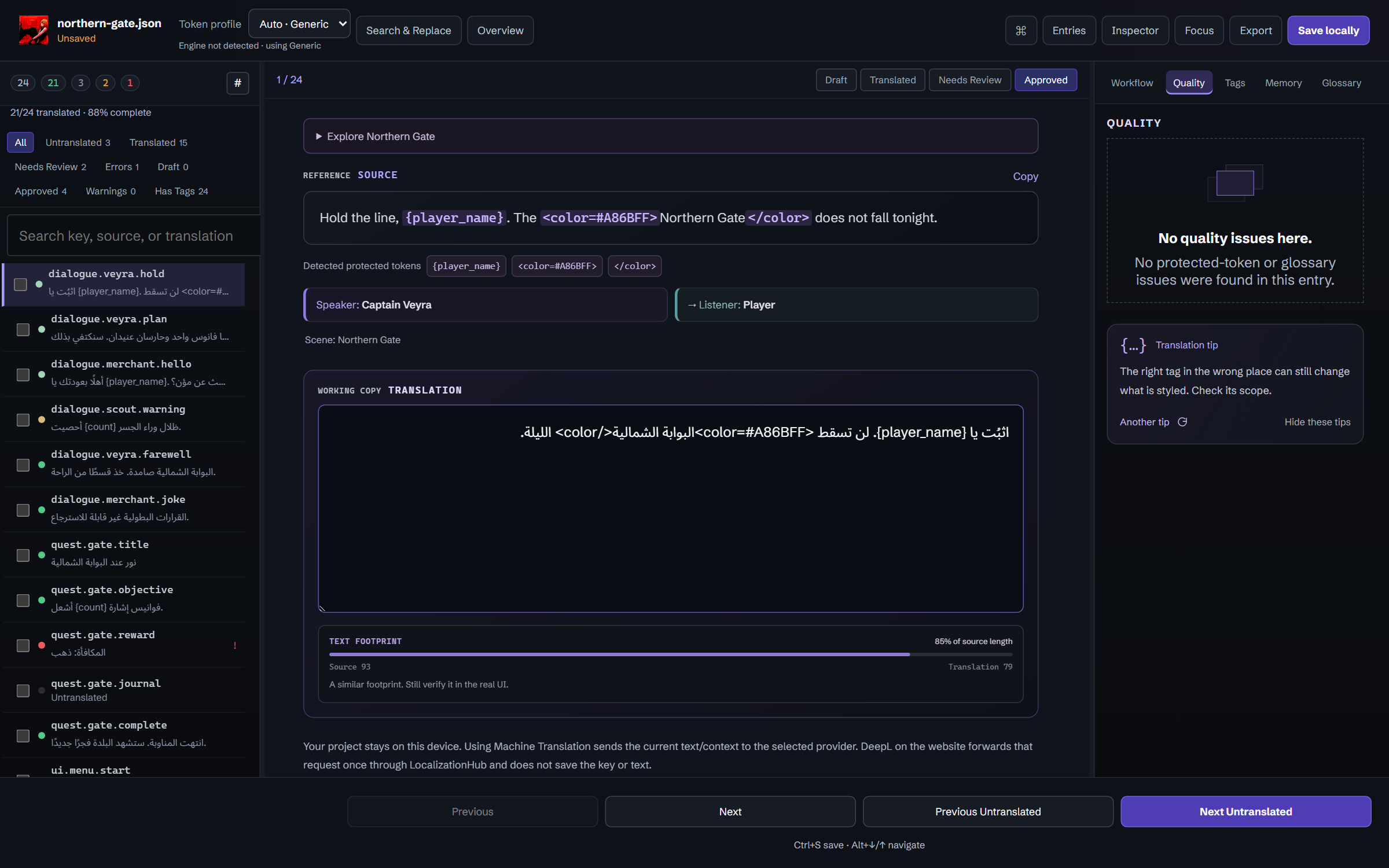
The LocalizationHub editor with the Northern Gate sample open: the entry list on the left, the selected line with its speaker, listener and scene in the middle, and the quality, memory and glossary tabs on the right.
A look inside the editor
  • ContextSpeaker, listener and scene sit beside the line.
  • Protected tokensHighlighted in the source, listed under it, and checked before export.
  • Memory and glossaryQuality, translation memory and terms stay beside the line.

See what still needs review

Draft, Translated, Needs Review, or Approved: give each entry a status so everyone knows what is ready.

Keep names and terms consistent

Keep character and place names in a glossary. Reuse earlier wording from Translation Memory instead of translating it again.

Keep the discussion beside the line

Assign entries and leave comments where they belong. Review changes or restore an earlier translation when needed.

Find the line you need

Search by text, status, or tag. Select several entries to update them together.

LOCAL OR CLOUD

Local Projects

Open files without uploading them. Web projects stay in this browser, so export a backup before clearing browser data. The installed desktop app also works offline.

LOCAL-FIRST

Cloud Projects

Invite your team to a shared project. Owners manage access, Editors translate, and Viewers can read without changing anything.

OPTIONAL CLOUD
FIELD NOTES / FOR TRANSLATORS

Notes from the translation desk.

Practical reminders for dialogue, terminology, and review.

Before you
start translating.

Where is the Windows app?

The Windows app is currently available to approved testers. The browser editor remains publicly available.

Can I work offline?

The installed desktop app works offline with local files. Loading the website, Cloud Projects, sign-in, LH Radio streaming, and online translation services require a connection.

Does my work stay on this machine?

Local web projects stay in the browser where you saved them. They do not appear in another browser and may be lost if its data is cleared. Export a copy for backup.

Does machine translation keep my text?

LocalizationHub keeps provider API keys in memory only and does not store the text you translate. DeepL on the website briefly passes the session key and current text through LocalizationHub to DeepL when you press Translate; neither is kept. The provider’s own policy still applies to what you send.

Start with a file.

Open your file in the editor, or try the Northern Gate sample. No account needed.

Open the editor